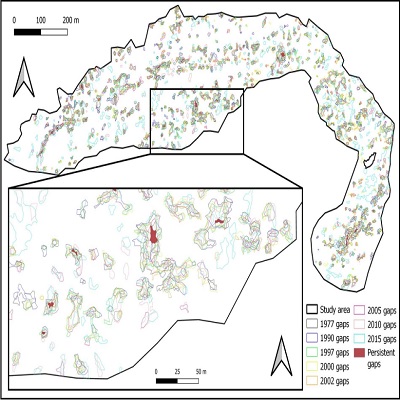
Understanding forest development following the cessation of management remains a key challenge in forest ecology. Gap dynamics, a driver of structural and compositional change, might serve as an important indicator of progression toward old-growth conditions. This study investigates and compares the long-term gap dynamics of two Central European forest reserves (Kékes—old-growth and Őserdő— long untouched) dominated by European beech (Fagus sylvatica L.) over a 42–45-year period, using aerial imagery. Our aim was to assess how historical management legacies influence gap size, formation, persistence, and closure, and to evaluate these processes relative to the forests’ naturalness levels. Gap fractions ranged between 4.9%–9.9% in Kékes and 2.3%–10.7% in Őserdő. These values are mostly consistent with previous reports for primary European beech forests. In Kékes, smaller gaps (<200 m2) predominated, while in Őserdő following a sequence of recent disturbances, gaps of 200–499 m2 became dominant. Statistical analyses revealed a significantly steeper increase in total gap area in Őserdő, reflecting greater sensitivity to exogenous disturbances, likely due to its more homogeneous stand structure and residual management effects. Site conditions, browsing pressure, and topography might have further contributed to the observed divergence. Our results indicate that the fine-scale endogenous dynamics, typical of old-growth forests (characterized by small, recurring gaps of endogenous processes), develop only several decades after the last human intervention. The study highlights that gap dynamics might serve as an indicator of forest naturalness and can guide restoration planning. Promoting structural heterogeneity and mimicking natural gap processes may accelerate recovery toward old-growth characteristics in formerly managed forests.